The Science of Staying Consistent
Why is it so easy to start a fitness plan… and so hard to keep going?
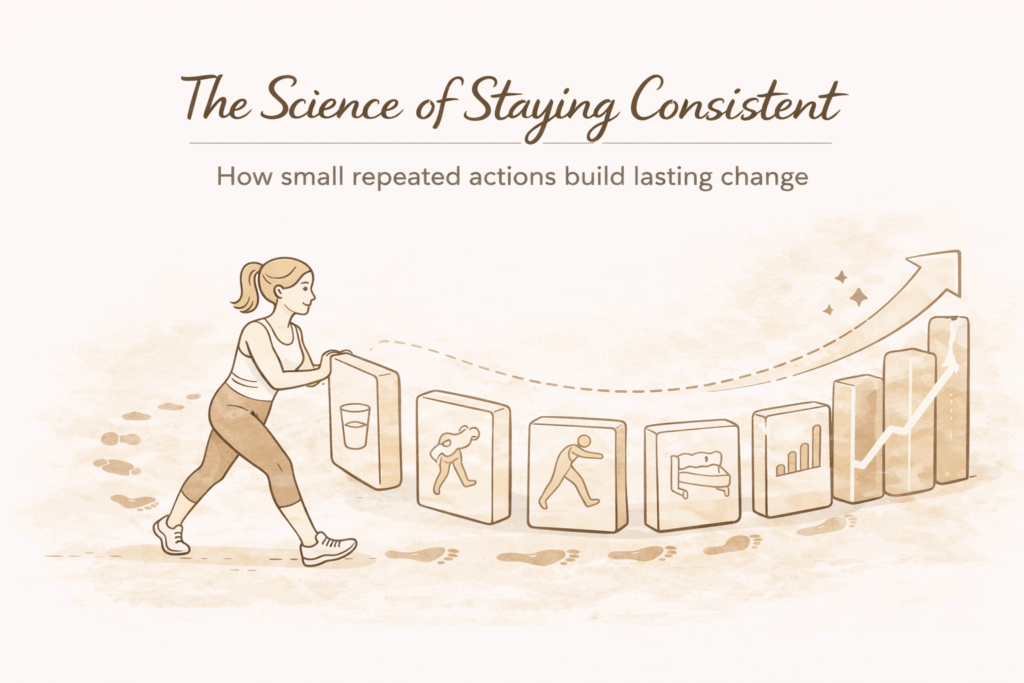
Motivation, some would say. But motivation is a short-term resource. Real progress is something else entirely. It is a system you build- and a pattern your brain learns.
The truth is simple: your results don’t come from what you do occasionally. They come from what you repeat.
Consistency Isn’t Perfection – It’s Returning
Consistency does not mean training every day. It doesn’t mean never missing a session. It means coming back before a break turns into a new “starting over.”
A realistic definition of consistency looks like this:
- You keep your routine alive, even when life gets busy.
- You train in smaller versions instead of skipping completely.
- You avoid the spiral of “I missed one day, so the week is ruined.”
One of the simplest rules is this: never miss twice. If you skip today, you don’t skip tomorrow.
Your Brain Is Built for Repetition
There’s something important most people never think about: your brain is constantly looking for ways to make life easier. It prefers familiar patterns, repeated actions, and routines that require less effort over time.
New actions require attention and decision-making. Repeated actions become automatic. Over time, the brain builds patterns that require less mental energy. This is why the first weeks feel harder- and why repetition is the real “secret.”
You don’t become consistent by forcing yourself harder. You become consistent by making the action easier to repeat.
Lower the Barrier, Increase the Reps
One of the biggest threats to long-term training isn’t lack of motivation- it’s friction. The small, almost invisible obstacles that make starting feel heavier than it should be. Looking for space, deciding what to do, changing clothes, clearing time in your schedule- each tiny step adds resistance.
When too many of these small barriers stack together, the brain quietly decides that skipping today is easier.
That’s why the first goal is not intensity. It’s removing friction.
- Have a default workout time (even if it stays flexible).
- Keep your workout space ready- a mat, water, and enough room to move.
- Reduce decisions so you don’t ask yourself every day: “What should I do today?”
When the path is simple, starting feels lighter. And when starting feels lighter, repeating the action becomes much more natural.
Use the Smallest Version That Still Counts
On low-energy days, the problem is rarely movement. It’s the size of the request you’re making of yourself.
Instead of asking for a full workout, ask for the smallest version you can complete without negotiation:
- 5 minutes of mobility
- 10 minutes of bodyweight movement
- One short circuit
- A simple walk
Small sessions protect the habit loop. They keep the identity alive: “I’m someone who trains.”
This is why micro workouts can be surprisingly effective when done regularly. (See: Micro Workouts: Do They Really Work?)
Track Something Simple
One of the easiest ways to stay on track is to make your effort visible. When you can see the days you showed up, the habit starts to feel real.
You don’t need complicated apps or detailed statistics. In fact, simple tracking systems often work best. A basic habit chain is enough:
- A calendar where you mark the days you trained
- A weekly checklist with a realistic goal (for example, 3–4 sessions)
- A simple “streak” mindset that focuses on returning – not on perfection
Over time those small marks become motivating on their own. Your brain begins to associate effort with visible progress, and visible progress makes repeating the habit much easier.
Design Your Environment for Automatic Action
Many habits fail not because people lack discipline, but because the environment around them makes the habit inconvenient.
When something requires too many small preparations, the brain postpones it. But when the environment is arranged for movement, action becomes almost automatic.
Small adjustments can make a surprising difference:
- Keep your workout clothes somewhere visible
- Leave your mat ready instead of storing it away
- Prepare a simple space where you can start moving immediately
When the environment supports the habit, starting requires less thought and less negotiation with yourself.
If you’d like to explore how environment shapes behavior, read Why Your Environment Shapes Your Results.
Why People Quit (And How to Prevent It)
Many people quit when the “newness” wears off. The early excitement fades, and the brain stops giving you the same emotional reward.
This is normal. It’s not failure. It’s biology.
The solution is not to wait for motivation to return- it’s to rely on structure. When the plan is small enough, clear enough, and easy to repeat, the habit continues even when motivation drops.
Showing Up Is a Learned Skill
The ability to keep going is not something people are simply born with. It is a pattern you train over time.
Lower friction. Make the action small enough to repeat. Protect the habit on low-energy days. And return before a short pause turns into a full restart.
If you want a structured system built around simple home sessions (without equipment), explore the 30-Day Home Weight Loss Program.
Because lasting results rarely come from occasional bursts of intensity. They come from showing up often enough that the routine starts to feel normal.