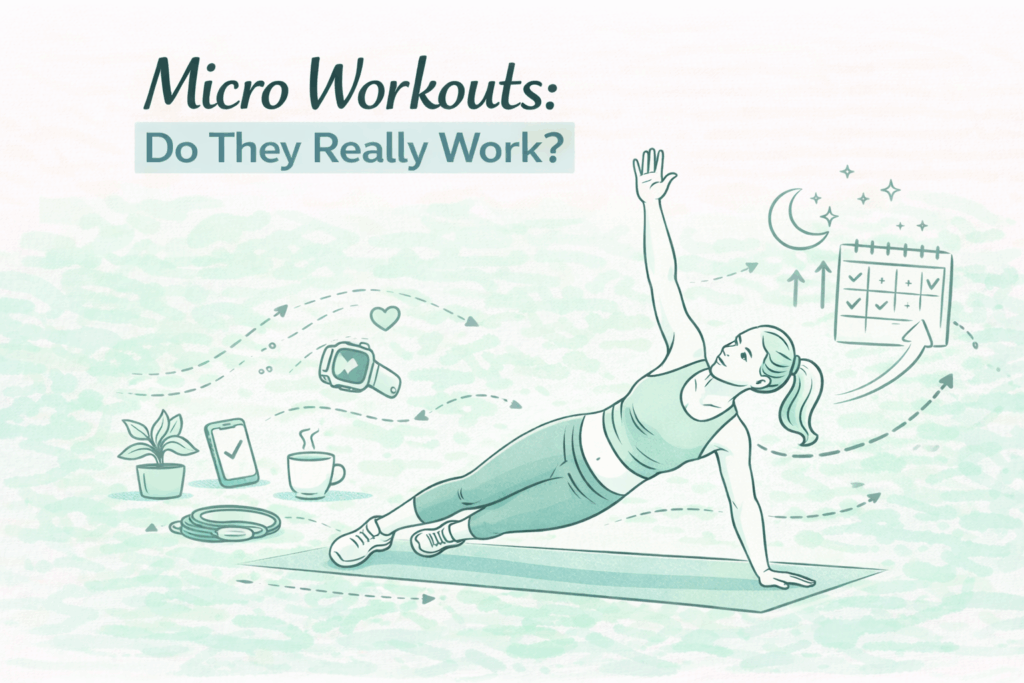
Micro Workouts: Do They Really Work?
Do you believe a workout needs to be long, exhausting, and difficult to actually “count”? That you need to spend an hour in the gym to get in shape? And that a 10-minute workout could never realistically change your body?
Because of that mindset, many people end up doing… absolutely nothing.
We prefer to postpone movement and come up with thousands of reasons not to start, like: “I do not have enough time today”, “Ten minutes is pointless anyway”, “If I cannot do a full workout, I will start tomorrow”.
Sometimes we only need one excuse not to do something — and thousands of reasons to finally begin. It doesn’t need to be this way.
And honestly, this is exactly where micro workouts can help. They make movement feel smaller, easier to start, and much more realistic to repeat consistently.
What Is a Micro Workout?
A micro workout is simply a short workout session, usually between 5 and 20 minutes.
It can be a few bodyweight exercises, a short strength circuit, a quick mobility flow, light stretching, walking intervals, or low-impact cardio. The point is not to replace every full workout forever, but to keep the body moving when a longer session is not realistic.
A short workout still increases circulation, activates muscles, reduces stiffness, supports mobility, and keeps the habit alive.
For many people, the biggest advantage is not what happens during those 10 minutes. It is what happens afterwards. A short session often creates momentum. Once the body starts moving, people frequently continue with a walk, some stretching, or simply make healthier choices throughout the rest of the day.
Starting a 10-minute session feels psychologically easier than preparing mentally for an exhausting 90-minute workout after a stressful day. Especially when you also include the time spent getting ready, traveling to the gym, and coming back home.
Who Micro Workouts Work Best For
Micro workouts are not only for “busy people.” They are especially useful for people who struggle with the hardest part of fitness: starting.
Because sometimes the problem is feeling physically heavy, low energy after work, being embarrassed to go to the gym, etc. And when fitness starts feeling mentally too big, people often avoid movement completely.
This is where psychology starts playing a huge role. If movement feels smaller, safer, and easier to start, the brain usually stops resisting it so much.
For example, many people who cannot imagine doing a full gym workout can still manage 10 minutes at home or a few simple exercises in the morning. Even light stretching before bed or a short walk after dinner is enough to keep the body moving.
That is why micro workouts can be useful for almost anyone. Busy professionals often have enough motivation but not enough time. Parents may spend the entire day taking care of everyone except themselves. People returning after a long break often feel overwhelmed by the idea of jumping straight into a full fitness routine.
And then there are people who simply feel stuck. They know they should move more, but every workout feels too big, too complicated, or too difficult to start.
For all of these situations, shorter workouts can lower the mental barrier that usually stops movement before it even begins.
Because sometimes the biggest fitness victory is simply getting started.
What an Effective Micro Workout Actually Looks Like
One mistake people often make is believing short workouts need to become extremely intense to “compensate” for being shorter.
But usually, the more exhausting and unrealistic the workout feels, the harder it becomes to repeat consistently. A simple and realistic structure often works much better.
10–15 Minute Beginner Micro Workout
- 30 seconds squats
- 30 seconds wall push-ups
- 30 seconds marching in place
- 30 seconds glute bridges
- 30 seconds rest
Repeat for several rounds at a comfortable pace and take breaks when needed.
Controlled movement with good form is usually more useful than rushing through exercises just to feel exhausted.
And if your energy is low, you can make it even simpler. Stretch for five minutes. Walk for ten. Do a few mobility exercises. It still counts.
A workout you can actually repeat will always help more than a “perfect” plan you constantly postpone.
Where Micro Workouts Fit Best During the Day
One reason micro workouts work so well is because they fit into moments where people normally do nothing. And this makes them much easier to maintain long-term.
Some people move for ten minutes before their morning shower. Others do a quick session during lunch break. Some stretch while dinner is cooking. Others take a short walk after work before sitting down for the evening.
There is no perfect time. The best time is usually the moment that already exists in your day and does not require a complete schedule change.
That is one reason micro workouts feel easier to maintain. They adapt to life instead of forcing life to adapt to them.
For people who want a more structured approach without spending hours training, the 30-Day Home Transformation Program combines realistic home workouts, daily movement, and routines designed for normal everyday life.
The Real Benefit Nobody Talks About
The biggest benefit of micro workouts is not only physical, but also psychological. They change the way people think about exercise.
A short session teaches your brain that movement does not have to be dramatic or extreme. You do not need to prepare for an hour. You do not need to wait for perfect motivation. You do not need to feel fully ready.
You can simply move for a few minutes. Because habits rarely disappear on good days. They disappear on difficult days.
And this is exactly where micro workouts become valuable. They give you a fallback option when life gets busy, energy is low, or motivation is nowhere to be found.
A five-minute session may not feel impressive in the moment, but it helps you stay connected to the habit instead of abandoning it completely. And often, maintaining the habit is more important than having the perfect workout.
Frequently Asked Questions
Do micro workouts really work?
Yes. The biggest advantage of micro workouts is that people actually do them. When repeated consistently, they can improve fitness, support weight loss, increase daily movement, and help build long-term exercise habits.
Is 10 minutes really enough to make progress?
Yes. Ten minutes may not seem like much, but repeated consistently, it can improve fitness, mobility, daily activity levels, and exercise adherence. For many people, ten minutes done regularly creates far better results than one long workout that keeps getting postponed.
What if I am completely out of shape?
That is exactly where micro workouts can help. Starting with five or ten minutes of simple movement often feels much less intimidating than jumping straight into a full fitness program. The goal is not to do everything at once. The goal is simply to start moving again.
Can walking count as a micro workout?
Yes. Walking is one of the easiest and most sustainable forms of daily movement, especially for beginners or people returning after a long break.
Is a short workout better than skipping movement completely?
Almost always. Even a few minutes of movement helps maintain the habit, supports circulation, and keeps momentum alive.