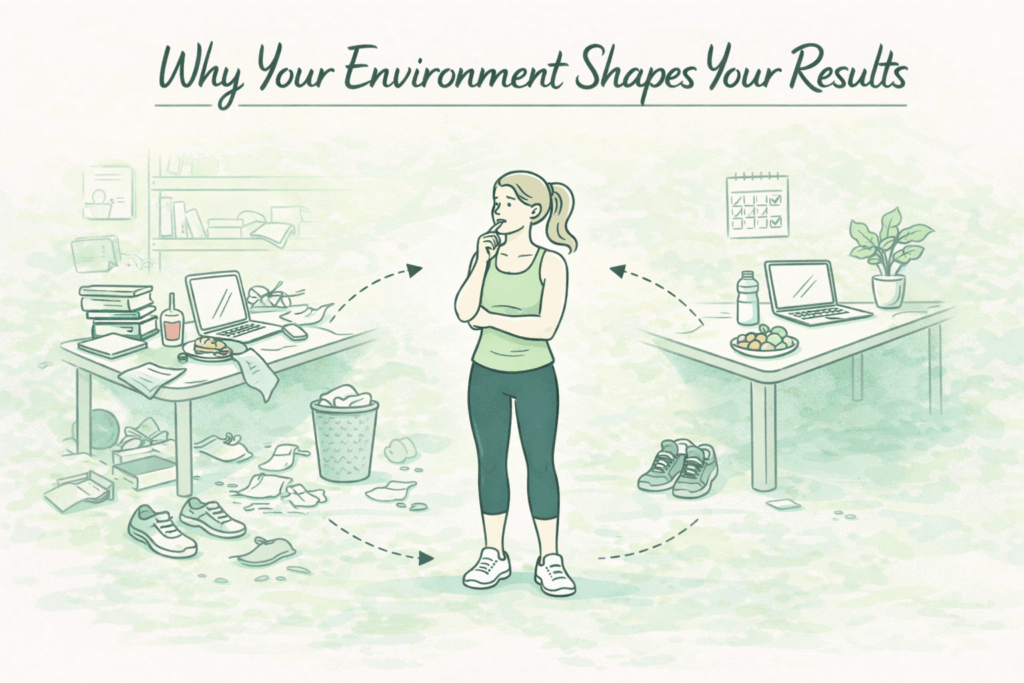
Why Your Environment Shapes Your Fitness Results More Than Motivation
Ppeople often struggle to stay consistent with workouts, not because they lack discipline, but because their environment makes it harder to act. What if your results are not limited by your discipline… but by your environment?
It’s common to rely on motivation, willpower, or strict routines. But your daily actions are influenced far more by what’s around you than by what you feel in the moment.
Your environment quietly shapes your habits, your energy, and your ability to keep moving.
Your Environment Is the Invisible Force Behind Your Habits
It’s easy to think that results come from discipline alone. But your environment constantly guides your behavior.
The layout of your space, what you see, how easy it is to start- all of these factors influence what you do each day.
Research in behavioral science suggests that a large part of daily habits is driven by environmental cues rather than conscious decisions. In other words:
- what you see influences what you do
- what is easy gets repeated
- what requires effort gets avoided
This is why change becomes much easier when your environment supports it.
Why Environment Matters More Than Motivation
Motivation changes constantly. Your energy, your mood, your stress levels- all of these affect how you feel. However, your environment is always present. It either supports your actions… or makes them harder.
A supportive environment reduces friction. And when friction is low, action becomes easier. This is one of the main reasons why structure works better than relying on motivation alone.
The Home Advantage: Why Environment Matters in Fitness
Your training environment directly affects whether you start or skip.
At home, you control:
- your space
- your timing
- your level of comfort
- your level of pressure
In other environments, like the gym, many of these factors are unpredictable. For example:
- crowded spaces
- noise and distractions
- waiting time
- feeling observed or judged
Each of these adds friction- small barriers that make it harder to start and easier to skip.
This is one of the reasons why many people find it easier to stay consistent with home workouts.
As explored in why home workouts often work better than the gym, removing these barriers makes regular training much more realistic.
A short session at home, even just 10–20 minutes, is often more realistic than planning a full gym visit with travel and preparation. That small difference is what makes regular training possible.
For example, someone who plans to go to the gym after work may skip it due to traffic, time, or low energy. But a 15-minute session at home removes those barriers completely. This is especially important for people trying to stay consistent with home workouts, lose weight, or build a daily fitness routine.
How Your Environment Shapes Your Identity
Your environment doesn’t just influence your actions. It also shapes how you see yourself.
When your space supports movement, your brain begins to associate that space with action. Over time, this creates a subtle identity shift:
- “I am someone who moves regularly”
- “I take care of my body”
- “this is part of my routine”
This is the same process described in how small daily decisions shape your body.
And once identity begins to change, behavior becomes easier to maintain.
How to Build an Environment That Supports Your Goals
You don’t need a perfect setup- you need a supportive one.
Here are simple ways to create it:
1. Create a Visible Space for Movement
Even a small area, a mat or a corner, can act as a trigger for action. When you see your workout space, your brain is reminded to move.
2. Reduce Friction
Keep your workout essentials visible- your mat, water bottle, or light equipment. If starting takes less than 10 seconds, you are far more likely to begin.
3. Use Consistent Cues
The same space, time, or playlist helps your brain recognize the pattern.
After a while, your body begins to associate that cue with movement.
4. Keep Your Workouts Short and Clear
A simple 10–20 minute routine is easier to follow than a long, complex plan. For example, a quick session might include:
- bodyweight squats
- push-ups or incline push-ups
- lunges
- core exercises like planks
These movements activate multiple muscle groups and can be done without equipment.
5. Follow a Structured Plan
If you don’t want to think about what to do each day, follow a system.
For example, the 30-Day Home Weight Loss Program is built around short, repeatable workouts designed for real-life schedules.
Why Small Environmental Changes Improve Fitness Results
You don’t need to change everything at once. Small adjustments in your environment can quickly improve:
- how often you start a workout
- how easy it feels to move
- how regular your weekly training becomes
And regular training is what allows your body to adapt. Regular movement supports:
- better energy levels
- improved metabolism
- stronger muscles and endurance
- more stable daily activity
These changes don’t come from one perfect session. They come from repeated action.
Your Environment Can Either Support You- Or Work Against You
You don’t need more motivation – you need a space that makes action easier.
A space that reminds you. A space that supports you. A space that reduces resistance.
And that space is already available to you. You just need to shape it in a way that makes movement easier to start and easier to repeat.
Frequently Asked Questions
Can my environment really affect my fitness results?
Yes. A supportive environment makes it easier to start and repeat workouts, which is the key to long-term results.
Do I need a lot of space to work out at home?
No. Even a small area is enough if it is consistent and easy to use.
How can I make workouts easier to start?
Keep your setup visible and simple. The easier it is to begin, the more likely you are to follow through.