The Psychology of Small Daily Habits
Big transformations don’t begin with big decisions. Contrary to what most people believe, they begin with small daily actions that quietly reshape your brain, your identity, and your future.
Why Small Actions Feel Insignificant (But Aren’t)
The human brain is wired to notice dramatic change. We are impressed by intensity, visible effort, and bold declarations. Small actions, on the other hand, feel almost invisible. A 10-minute workout doesn’t feel life-changing. A short walk doesn’t feel transformative.
But biology doesn’t respond to drama- it responds to repetition. Your body adapts to what you do consistently, not to what you do occasionally. This is why daily micro-choices shape your body more than big goals.
The Habit Loop: Cue, Action, Reward
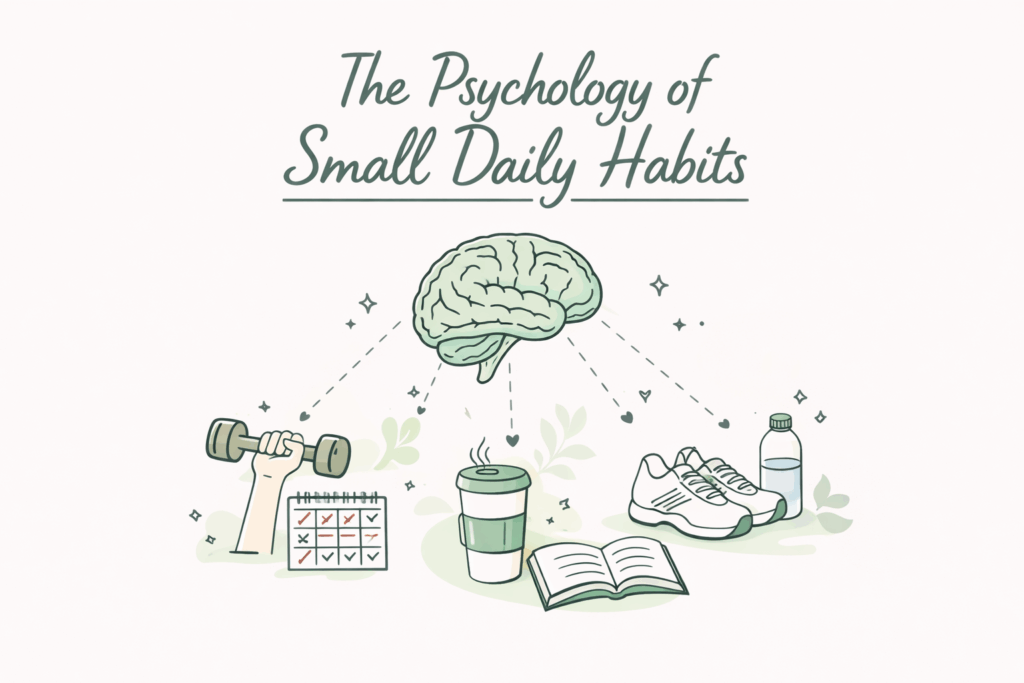
Every habit follows a simple neurological pattern:
- Cue – a trigger that starts the behavior
- Action – the behavior itself
- Reward – a positive feedback signal (often dopamine)
When you repeat this loop, your brain strengthens the neural pathway. The action becomes easier, more automatic, and less emotionally resistant. This is why small habits are powerful – they are easier to repeat, and repetition is what wires behavior into identity.
How Small Wins Rewire Your Brain
Each completed action, even a small one, gives your brain a signal: “I follow through.” That signal matters more than intensity.
Small wins:
- Increase self-trust
- Reduce resistance to starting
- Create momentum through dopamine feedback
- Lower the psychological barrier for tomorrow
This is also why quick wins matter more than long workouts. You are not just training your body – you are training your consistency.
Identity Is Built Through Repetition
Transformation becomes sustainable only when it becomes part of who you are. Identity is not built in one intense week. It is built through repeated proof.
When you move your body every day, even briefly, you reinforce the identity: “I am someone who takes care of my health.”
If you want to understand this shift deeper, read why weight loss begins with an identity shift.
Why Small Habits Beat Extreme Plans
Extreme plans demand extreme energy. Small habits demand consistency. And consistency wins.
The brain doesn’t measure effort – it measures repetition. Neural pathways strengthen through frequency, not intensity. What you do regularly becomes automatic. What you do occasionally remains optional.
Psychological research supports this. A well-known study from University College London found that, on average, it takes about 66 days for a new behavior to become automatic – though the range can vary from a few weeks to several months depending on the complexity of the habit. The key variable wasn’t intensity. It was consistency.
Habits are formed through repeated exposure to the same cue and action pattern. Each repetition reduces friction, lowers mental resistance, and strengthens the neural pathway involved. Over time, the behavior requires less emotional negotiation and less conscious effort.
This is why small daily habits are so powerful. They are easier to repeat long enough to cross the threshold from effort to automation. And once a behavior becomes automatic, it stops depending on motivation.
In that reason consistency matters more than intensity in long-term fitness success.
Small Habits Reduce Decision Fatigue
Large goals create mental pressure. Small habits reduce it. When your routine is simple and repeatable, you don’t negotiate with yourself every day.
Decision fatigue is one of the biggest hidden enemies of fitness progress. The more complex the plan, the more likely you are to delay it. Small daily habits remove friction and make action automatic.
Environment Shapes Repetition
Habits don’t exist in isolation. They are shaped by environment. A prepared space, visible cues, and reduced friction increase the chance that small actions happen consistently.
If you want to go deeper on this, read why your environment shapes your results and why home workouts beat the gym.
A Practical Way to Start Today
If you want to apply the psychology of small habits immediately, start here:
- Commit to 5–10 minutes of movement daily.
- Attach the habit to an existing routine (after coffee, after work, before shower).
- Prepare your environment in advance.
- Track completion — not intensity.
The goal is not exhaustion. The goal is repetition.
From Small Habits to Real Transformation
Small daily habits are not a shortcut – they are the foundation. When structured properly, they become a system that supports your life instead of competing with it.
If you want a guided framework built around realistic repetition, explore the 30-Day Home Weight Loss Program. If you prefer a fully adaptive system that adjusts to your energy, schedule, and goals, discover the AI Personal Fitness Coach.