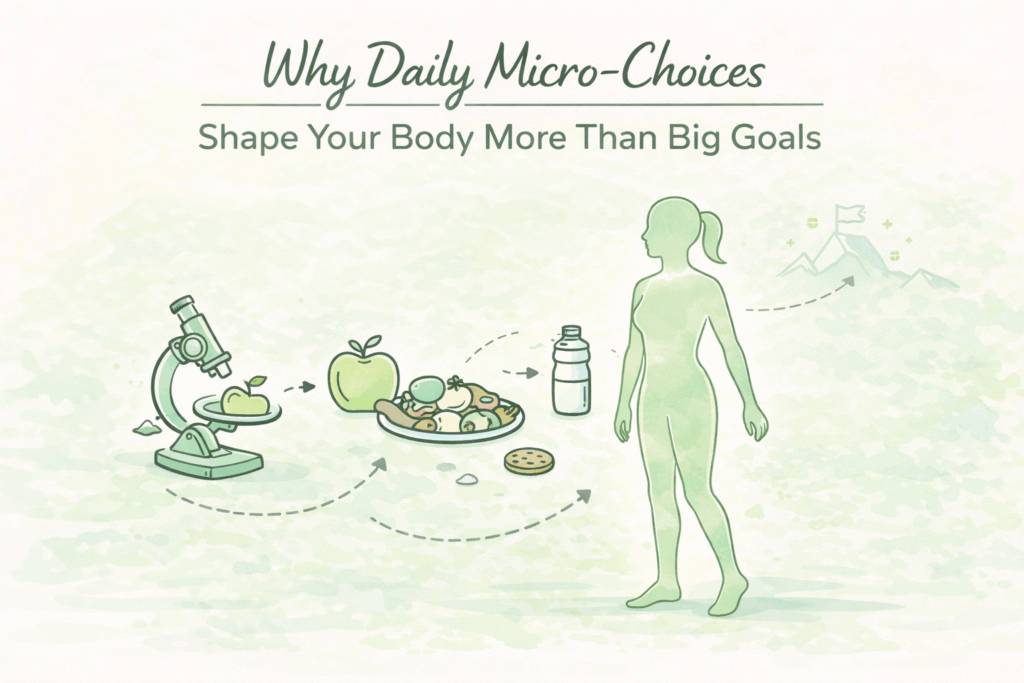
Why Daily Micro- Choices Shape Your Body More Than Big Goals
What if your results are not defined by big decisions… but by the small ones you repeat every day?
Big goals feel powerful. They give direction. They create excitement.
But your body does not respond to goals. It responds to what you actually do- daily, repeatedly.
If you’re trying to lose weight or stay consistent with workouts, small daily actions are often what make the biggest difference.
Why Big Goals Often Don’t Lead to Real Change
Big goals create pressure. They often lead to extreme plans- long workouts, strict routines, sudden lifestyle changes. And while that can feel motivating at first, it rarely lasts.
When the plan feels too demanding, it becomes harder to repeat. And what cannot be repeated cannot create results.
What Actually Drives Physical Change
Your body adapts to repeated signals. Not to intensity. Not to intention. But to repetition. This is how processes like metabolism, muscle activation, and energy production improve.
Every small action sends a signal:
- move → adapt
- train → get stronger
- stay active → improve energy
And those signals shape your results.
What Micro Choices Look Like in Fitness
In real life, progress comes from small, repeatable actions.
For example:
- doing a 10–20 minute workout instead of skipping the day
- choosing to move even when energy is low
- going for a short walk instead of staying inactive
- starting even when you don’t feel fully ready
These actions may seem small in the moment. But they are exactly what your body responds to. A short workout done regularly will outperform a perfect plan that is abandoned after a few days.
Why Small Actions Are Easier to Repeat
Your brain naturally avoids things that feel overwhelming. Large plans create resistance before you even begin. Small actions feel manageable. And when something feels manageable, you are far more likely to do it again. That is how consistency is built.
Why Repetition Matters More Than Intensity
Your body does not need extreme effort. It needs repeated stimulation.
Regular movement supports:
- better metabolism
- improved energy levels
- stronger muscles
- more stable daily activity
These changes come from frequency, not from occasional effort.
As explained in this article on consistency, repetition is the key driver of real progress.
How to Turn Small Choices Into Real Results
You don’t need a perfect plan- you need something simple enough to repeat. Because results don’t come from what looks impressive. They come from what actually gets done.
The goal is not to do everything at once, but to create a pattern your body can follow daily.
Start with:
- a short daily workout that feels manageable
- a clear and simple structure you don’t have to think about
- removing unnecessary decisions that create hesitation
For example, instead of planning long sessions a few times a week, focus on short, consistent movement every day.
Even 10–20 minutes of focused activity can activate your muscles, improve circulation, and support your metabolism.
What matters is not the size of the action- but how often you repeat it. Once the action becomes part of your routine, it stops feeling like effort and starts feeling natural.
If you want a system built around small daily actions, you can explore the 30-Day Home Weight Loss Program, designed to make daily movement simple and repeatable.
Small Actions Build Big Results
Progress does not come from what you plan to do- it comes from what you repeat. One small action today may not feel like much. But repeated daily, it becomes transformation.
Frequently Asked Questions
Do small workouts really work?
Yes. Short workouts done regularly are more effective than long sessions done occasionally.
How quickly can I see results?
With consistent daily action, changes often begin within a few weeks.
What if I miss a day?
Missing one day does not stop your progress. What matters is returning to your routine the next day and continuing the pattern.
Is it better to do a short workout or nothing at all?
A short workout is always better. Even a few minutes of movement keeps the habit alive and signals your body to stay active.