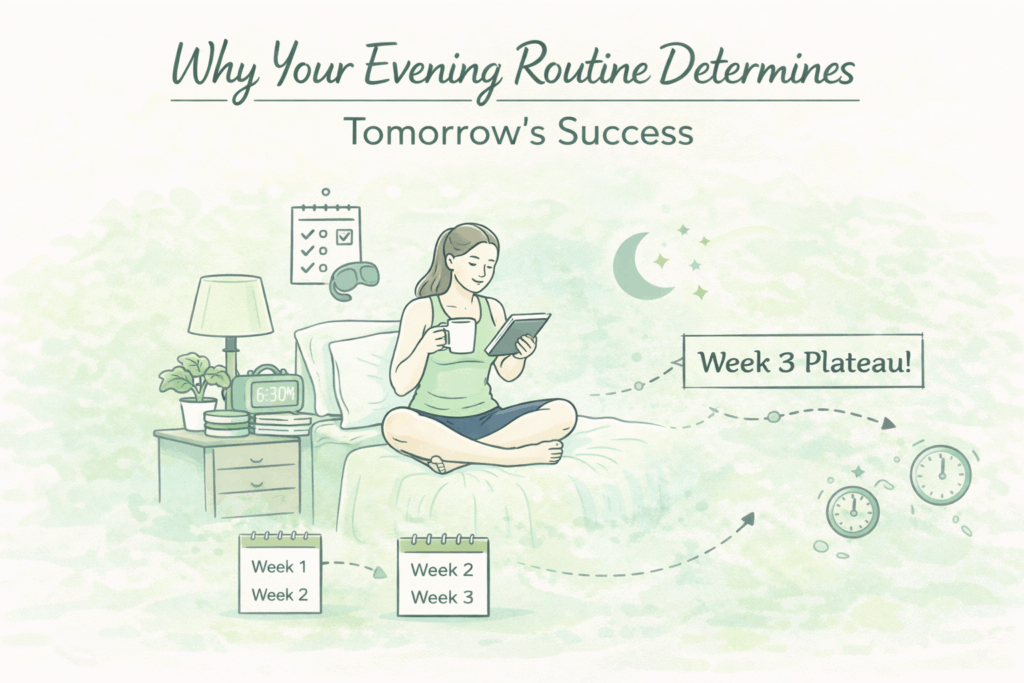
Why Your Evening Routine Determines Tomorrow’s Fitness Results
Think about how often this happens.
You are tired after work. You sit down “for a few minutes.” One video becomes five. One episode becomes three. Suddenly it is midnight and you are wondering why getting up tomorrow feels impossible.
Almost nobody plans to sabotage tomorrow. It usually happens one small decision at a time.
Your energy, your mood, your cravings, and your willingness to move tomorrow are often shaped by what happens tonight. That is why an evening routine is not only about sleep. It is about creating better conditions for tomorrow.
Why Most People Ruin Tomorrow Before Today Ends
Lot’s of people think fitness results are decided only during workouts. But often, they are quietly influenced much earlier. Like at 10 PM, when the day is almost over.
A late heavy meal, endless scrolling, answering work messages in bed, watching three more episodes, drinking too much caffeine late in the day, or staying awake “just a little longer” may not feel like a big deal in the moment. But together, these choices often create the exact conditions that make tomorrow harder.
You wake up tired. Movement feels like a burden. Cravings become stronger. Coffee becomes mandatory instead of optional. And suddenly it feels like you lack motivation, when in reality your body simply did not recover well enough. Does it sounds familiar?
The Hidden Link Between Evenings and Fitness Results
It is easy to blame the morning. “I was too tired.” “I did not have time.” “I woke up late.” “I did not feel motivated.”
But many morning problems start the night before. A typical example looks like this. You planned to do a 20-minute workout before work. But you stayed awake until midnight scrolling, slept badly, hit snooze twice, and suddenly there is no time left.
The workout was not cancelled in the morning. It was cancelled the night before.
The principle is simple: a chaotic evening usually creates a harder morning. A calmer evening usually creates a better starting point.
Better sleep, lighter digestion, lower stress, and fewer morning decisions can all make movement feel much easier the next day.
Said in other words: the last part of your day should stop working against the next one.
How Your Evening Affects Your Body, Not Just Your Schedule
The last 1–2 hours of your day affect far more than just your bedtime.
Your body follows a natural circadian rhythm, a 24-hour internal clock that helps regulate sleep, energy, hormones, appetite, and recovery.
When evenings are overstimulating, the body does not receive a clear signal that the day is ending. Bright screens, heavy meals, late caffeine, stress, noise, and work messages can keep the brain alert when it should be slowing down.
This can make sleep lighter, recovery weaker, and morning energy lower. And when the body wakes up already tired, fitness becomes much harder to follow through with.
That is why evening habits affect not only sleep, but also cravings, energy, motivation, and the ability to stay active the next day.
The Two-Minute Evening Check
Before bed, ask yourself two simple questions: “What is the first healthy thing I will do tomorrow?” and “What could stop me from doing it?”
This takes less than two minutes, but it forces the brain to think ahead.
For example, if tomorrow’s first healthy action is a morning walk, the obstacle might be going to bed too late. If tomorrow’s goal is a workout, the obstacle might be not knowing what workout to do.
Very often the solution becomes obvious once the obstacle is identified.
Many obstacles look much easier to solve the night before than at 6:30 AM when you are tired.
The 60-Minute Rule
If you want to improve tomorrow’s energy, pay attention to the last hour before sleep. You do not need a perfect evening ritual. But the final 60 minutes often matter more than people realize.
Try making that hour quieter than the rest of the day. Reduce notifications. Stop checking work messages. Lower the lights. Avoid heavy meals right before bed. Put the phone away earlier if you know scrolling keeps you awake.
Even 30–60 minutes of lower stimulation can help the brain and body understand that the day is ending.
Many people notice better sleep not because they suddenly changed everything, but because their mind finally gets permission to slow down before bed.
The Evening Trap That Creates Hard Mornings
One mistake appears again and again. People treat evenings as reward time.
After a long day they finally sit down, open social media, start watching videos, order food, snack while watching television, and tell themselves they deserve a break.
Honestly, they do deserve a break. The problem is that the break quietly turns into another two or three hours of stimulation. And instead of finishing the day rested, they finish the day mentally overloaded.
This is also why food decisions often become worse late at night. At the end of the day many people are simply tired, stressed, bored, emotionally drained, or looking for comfort. When the brain is exhausted, it naturally starts searching for easy rewards.
That is one reason why snacks, sweets, oversized portions, and “just one more treat” appear much more often at 10 PM than at 10 AM. As we explored in What Your Food Cravings Are Trying to Tell You , cravings are not always a sign of physical hunger. They can also be driven by stress, fatigue, habits, poor sleep, emotions, or the simple need for comfort after a long day.
The result often shows up the next morning. Lower energy. Stronger cravings. Less motivation to move. More dependence on caffeine.
Many people think they have a motivation problem when they actually have a recovery problem.
Improving evenings often improves eating habits automatically. Fewer cravings. Less mindless snacking. Better food decisions. Not because people suddenly develop more willpower, but because they stop making important decisions when they are mentally exhausted.
If making decisions every day feels exhausting, a simple structure can help. The 30-Day Home Weight Loss Program was designed around short, repeatable actions that remove much of the daily guesswork.
Why This Works Better Than Relying on Motivation
Morning motivation is unreliable because mornings are unpredictable.
Some days you sleep well. Some days you do not. Some days work is stressful. Some days it is not. Some mornings you wake up energized. Other mornings you wake up already tired.
That is why successful routines rely less on motivation and more on preparation.
When tomorrow’s workout is already chosen, clothes are ready, the evening is calmer, and sleep is better, the morning requires less negotiation.
You do not need to wake up as a completely different person. You only need to make the next healthy action easier to take.
We explored this idea further in How to Build a Workout Habit That Lasts , where simple repeatable actions often work better than waiting for perfect motivation.
Frequently Asked Questions
Can sleep affect weight loss?
Yes. Poor sleep can increase cravings, reduce recovery, affect appetite regulation, and make it harder to stay active consistently.
Can late-night screen time affect fitness results?
Indirectly, yes. Late-night screen time can reduce sleep quality, and poor sleep often leads to lower energy, stronger cravings, and less motivation to move the next day.
What should I do if I am too tired to work out in the morning?
Focus on recovery first. A short walk, light stretching, or simply returning to better sleep habits may be more useful than forcing an intense workout when your body is already overwhelmed.
Why do cravings feel stronger at night?
Because by the end of the day people are often tired, stressed, bored, or mentally drained. In many cases the brain is looking for comfort or stimulation rather than food itself.
Does working out at night affect sleep?
For some people, intense late-night workouts can make it harder to fall asleep. Lighter movement such as walking, stretching, or mobility work is often easier to recover from before bedtime.
Why do I feel tired even after sleeping?
Sleep duration is important, but sleep quality matters too. Late meals, screen time, stress, alcohol, and frequent interruptions can reduce recovery even if you spend enough hours in bed.