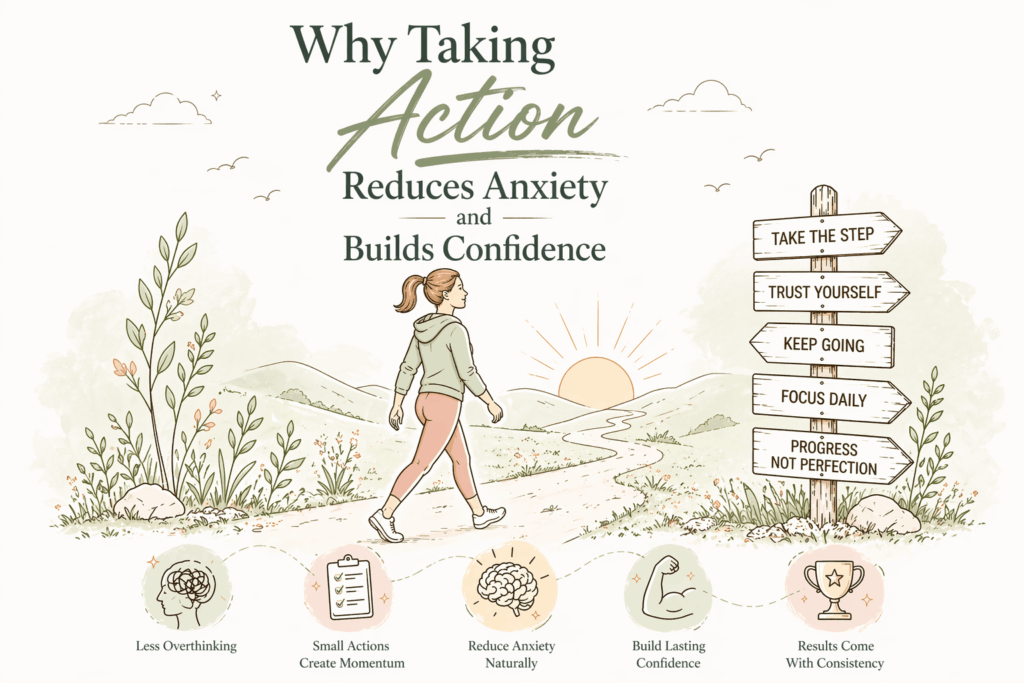
Why Taking Action Reduces Anxiety and Builds Confidence
Have you ever noticed how thinking about something often feels worse than actually doing it?
You delay starting. You overthink. You imagine worst-case scenarios. And the longer you wait, the heavier everything feels.
Then something changes. You take a small step. And suddenly, the pressure drops. That shift is not random. It is how your brain works.
Why Overthinking Increases Anxiety
When there is no action, the brain keeps searching for answers. It tries to predict outcomes, avoid mistakes and prepare for uncertainty. But without real feedback, it often fills the gaps with imagined scenarios.
And those scenarios are usually negative.
From a psychological perspective, uncertainty activates the amygdala– the part of the brain responsible for detecting threats. When something feels unclear, the brain treats it as a potential danger.
This is why overthinking creates anxiety:
- you imagine what could go wrong
- you delay action
- uncertainty increases
- stress builds
The longer you stay inactive, the stronger this loop becomes.
Action Creates Immediate Relief
Action breaks that loop. The moment you start moving, the brain shifts from prediction to experience. Instead of asking “What if?”, it begins processing “This is happening.”
This reduces uncertainty- and when uncertainty drops, anxiety often decreases as well.
Even small actions can create this effect:
- starting a short workout
- going for a walk
- doing a simple task you’ve been avoiding
The action doesn’t need to be perfect. It just needs to begin.
Why Movement Works So Fast on Your Mood
Movement is one of the fastest ways to regulate your mental state.
When you move, several important processes begin:
- blood flow to the brain increases
- oxygen delivery improves
- stress hormones begin to decrease
- neurotransmitters like dopamine and serotonin increase
These changes directly influence how you feel.
Research in psychology shows that even short bouts of movement can reduce symptoms of anxiety and improve mood within minutes. This is one reason physical activity is often recommended as part of stress management strategies.
As explained in Why Movement Actually Creates Energy (Not Exhaustion) , movement doesn’t just use energy- it helps regulate it.
Real-Life Example: Movement as Emotional Release
This connection between movement and emotional relief is not just theoretical.
:contentReference[oaicite:1]{index=1} has openly shared that she turned to exercise not only for physical change, but as a way to manage stress and process emotions.
Instead of focusing only on weight loss, movement became a form of mental release. That’s an important shift. Exercise is not only about appearance- it’s also a tool for emotional balance.
And that applies to everyday life, not just public figures.
Confidence Is Built Through Action, Not Thinking
Confidence is often misunderstood as something you need before you start. In real world, it is something you build after you act.
Each small action creates evidence:
- you showed up
- you handled it
- you moved forward
From a psychological perspective, this is how self-efficacy develops- your belief in your ability to handle situations improves through repeated successful actions.
That belief is what most people call confidence.
As explained in How Your Identity Shapes Your Fitness Success , repeated behavior gradually changes how you see yourself.
Simple Ways to Use Movement When You Feel Stressed
You don’t need a full workout to change your state.
When you feel anxious, irritated or mentally overwhelmed, small actions are often enough. Actions, such as:
- take a 10–15 minute walk
- do 10–20 bodyweight squats
- stretch your shoulders and back
- step outside for fresh air
- do a short 5–10 minute routine at home
These actions help your body shift out of a stress response and back into a more balanced state. The key is not intensity. The key is movement.
Why Small Actions Work Better Than Waiting
Waiting for the “right moment” often keeps you stuck. Small actions remove that barrier. They feel manageable. They reduce resistance. And they are easier to repeat.
This is why short sessions work so well. As shown in The Most Effective Short Home Workouts , even brief activity can create real impact when repeated regularly.
Progress doesn’t come from perfect plans. It comes from action that actually happens.
Action Changes Your State
Anxiety grows in stillness. While clarity grows in motion.
You don’t need to solve everything before you start. You only need to move. Because in most cases, better energy, clearer thinking and stronger confidence don’t come before action. They come from it.
Frequently Asked Questions
Why does taking action reduce anxiety?
Action reduces uncertainty and gives the brain real feedback instead of imagined scenarios, which lowers stress signals.
Can exercise improve mental health?
Yes. Physical activity supports neurotransmitters like dopamine and serotonin, which are directly linked to mood and emotional balance.
What if I feel too stressed to start?
Start with something very small — even a short walk or a few minutes of movement can help shift your state.
How quickly does movement affect mood?
Often within minutes. Even brief activity can improve how you feel almost immediately.
Does this help with daily stress?
Yes. Regular movement is one of the simplest and most effective ways to manage everyday stress and mental pressure.