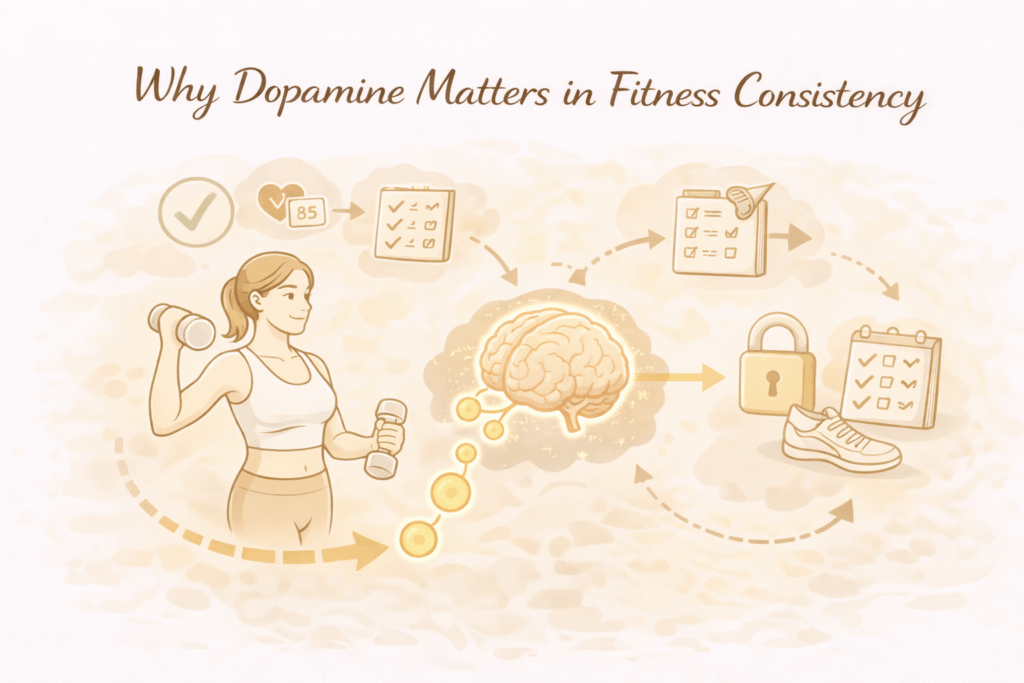
Why Dopamine Matters in Fitness Consistency
Why does exercise feel exciting at the beginning… and much harder a few weeks later?
Have you ever wondered why it’s easy to start a workout routine… but much harder to stay consistent after a few weeks?
You begin with motivation, energy and a clear plan. But then something changes. Workouts feel harder to start, routines break and consistency becomes difficult.
This is not just about discipline. It is strongly connected to how your brain works- especially to a neurotransmitter called dopamine.
What Dopamine Actually Is and What It Does
Dopamine is often called the “feel-good” chemical, but that description is too simple. It plays a major role in motivation, reward, anticipation, and habit formation. If you understand how dopamine works, it becomes much easier to understand why consistency feels natural some weeks and difficult in others.
It is a neurotransmitter involved in the brain’s reward and motivation systems. It helps drive behavior by making certain actions feel worth repeating. In simple terms, dopamine helps your brain say, “This matters. Do it again.”
From a scientific perspective, dopamine is released in areas of the brain linked to motivation and decision-making, such as the basal ganglia and prefrontal cortex. These regions help you evaluate effort, predict outcomes, and decide whether an action is worth repeating.
One of the most important discoveries in neuroscience is that dopamine is not only released when you get a reward. In many cases, it spikes before the reward- when your brain expects something positive to happen. This is known as “reward prediction.”
In simple terms, your brain is constantly asking: Is this worth doing again? If the answer is yes, dopamine helps reinforce the behavior. If the answer is unclear or negative, motivation drops.
This matters in fitness because exercise is rarely just physical. The brain is constantly evaluating effort versus reward. If a behavior feels pointless, confusing, or emotionally flat, it becomes harder to repeat. If a behavior feels rewarding, even in a small way, the brain becomes more willing to come back to it.
That is one reason people tend to stay more consistent with activities that provide quick feedback. A walk that improves mood, a short workout that creates a sense of accomplishment, or a routine that is easy to track, can all create a stronger motivational loop than a plan that feels overwhelming from the start.
In other words, consistency is not just about pushing yourself harder. It is about giving your brain enough signals that what you are doing is working- even if the results are still small.
Why Motivation Feels Strong at First and Then Fades
Have you noticed how a new workout plan often feels more exciting in week one than in week four?
That early excitement is not imaginary. Novelty itself can stimulate dopamine activity. New goals, new routines, and new expectations can all create a temporary motivational boost. The brain likes change when it predicts that the change might lead to something rewarding.
But the brain also adapts quickly. What felt fresh becomes familiar. What felt exciting becomes normal. This is one reason motivation drops even when a routine is technically working.
It does not always mean the program is bad. Sometimes it simply means the “novelty effect” has worn off.
This is where many people make a mistake. They interpret the drop in excitement as a sign that the routine is failing, when in reality the brain is just moving from excitement into habit-building territory. That stage feels less emotional, but it is often where real long-term progress begins.
In other words, the moment when motivation becomes quieter is often the moment when consistency becomes more valuable.
Why Small Wins Matter So Much
The brain responds strongly to progress. Not imaginary progress. Not vague promises. Real, visible, believable progress.
That is why small wins matter so much in fitness consistency. When a person checks off a workout, completes a short session, hits a step goal, or notices improved energy, the brain receives a signal that the effort led somewhere. That signal helps reinforce behavior.
This is also why extremely ambitious plans often fail. If the effort is too high and the reward feels too far away, the brain stops seeing the routine as attractive. It becomes harder to start, harder to repeat, and easier to avoid.
Small wins create momentum because they reduce the gap between action and reward. A 10-minute workout is easier to complete than a 60-minute one. A short walk after lunch gives immediate feedback. Even a simple streak calendar can help because it makes progress visible.
That is one reason shorter forms of movement can be surprisingly effective, both physically and psychologically. If you have read our article on micro workouts and whether they really work, you already know that small sessions can support real results when they are done consistently.
The brain likes completion. It likes patterns. It likes evidence that effort pays off. Small wins feed all three.
This is why even short daily workouts can create a strong consistency loop.
Why Consistency Beats Intensity From a Brain Perspective
There is a common belief in fitness that harder always means better. More sweat, more pain, more intensity, more results. But the brain does not always work that way.
From a neurological perspective, repeated behaviors are what matter most. The more often a behavior is performed, the more familiar and efficient it becomes. Over time, repeated actions strengthen neural pathways and make the routine feel less mentally expensive.
This is part of how habits form. Behaviors that begin with conscious effort can gradually become more automatic. The brain starts to recognize the pattern and reduce resistance.
That is why 15 minutes a day can outperform one massive workout done once a week. The shorter habit creates frequency. Frequency creates familiarity. Familiarity lowers friction. And lower friction makes consistency easier.
This principle also connects to energy. Many people assume exercise drains them, but regular movement often improves physical and mental energy over time. We explored that idea in more detail in Why Movement Actually Creates Energy, Not Exhaustion.
The brain does not reward what sounds impressive on paper. It rewards what becomes meaningful, repeatable, and connected to progress.
Why Some Fitness Plans Fail Before the Body Even Adapts
Sometimes a plan fails long before the body has had any chance to respond.
Not because the exercises are wrong. Not because fat loss is impossible. Not because someone lacks potential. The problem is often that the plan creates too much mental resistance.
If a routine feels confusing, too long, too strict, or too difficult to organize at home, the brain begins to treat it as a high-friction task. And high-friction tasks are easy to postpone.
This is where many people get trapped in the cycle of “starting over.” They are not lazy. They are repeatedly trying to follow systems that ask for too much before the routine has had time to become stable.
There is also an emotional side to this. When people miss a few workouts, they often feel they have failed. That feeling lowers motivation even more. A routine that once seemed exciting can start to feel like proof of inconsistency, and that emotional association weakens the dopamine-reward loop.
That is why sustainable fitness often works better when the structure is realistic from day one. The goal is not to impress yourself for four days. The goal is to create a routine your brain and body are both willing to return to next week.
How Structure Helps Dopamine Work in Your Favor
One of the easiest ways to improve consistency is to reduce decision fatigue.
Think about how many people lose momentum not during the workout itself, but before it even starts. What should I do today? How long should it be? Is this enough? Should I train or rest? Is it too late now? Those tiny decisions create friction, and friction drains action.
Structure changes that.
When a person follows a guided system, the brain spends less energy negotiating. Instead of constantly deciding, it starts recognizing a familiar pattern. That familiarity supports consistency because the action becomes easier to begin.
This is one reason personalized systems are becoming more useful in modern fitness. Tools that adapt workouts, track progress, and create realistic next steps can help maintain a stronger connection between effort and reward. Our AI Personal Fitness Coach is built around that idea: less confusion, more structure, and better follow-through.
The same principle applies to longer transformation plans as well. A clear path reduces mental clutter. When people know what to do next, consistency becomes less about forcing motivation and more about following a rhythm.
Dopamine, Identity, and the Feeling of Becoming “Someone Who Trains”
There is another layer to consistency that often gets ignored: identity.
At first, exercise feels like something you are trying to do. Later, if repeated often enough, it starts to feel like something that belongs to your life. That shift matters more than people think.
When the brain begins associating movement with your identity, the behavior stops feeling random. It becomes part of your self-image. You are no longer just “trying to work out.” You are becoming a person who moves, trains, and takes care of their energy.
This may sound psychological, but it has practical consequences. Identity-based habits are easier to maintain because they create internal consistency. The behavior feels aligned, not imposed.
That alignment also affects dopamine. The brain responds more positively to behaviors that fit an established pattern of self. The more familiar and self-reinforcing the routine becomes, the easier it is to repeat.
This is why consistency often grows quietly. Not with one dramatic burst of motivation, but through repeated proof: you showed up again, you finished again, and your brain started believing this is simply what you do now.
How to Use Dopamine to Stay Consistent
Understanding dopamine is useful. Using it is what creates results.
You can support your consistency by:
- choosing shorter workouts that feel achievable
- tracking small wins (even simple checkmarks)
- keeping routines clear and easy to follow
- reducing decisions before training
- focusing on completion, not perfection
These actions help your brain associate movement with progress and reward.
If you want a structured system that supports consistency through small, repeatable actions, you can explore the AI Personal Fitness Coach, designed to reduce friction and make daily training easier to follow.
Final Thoughts
Fitness consistency is not just about discipline, and it is not just about motivation either. It is about how the brain responds to effort, reward, progress, and repetition.
Dopamine plays an important role in that process. It helps explain why new routines feel exciting, why motivation fades, why small wins matter, and why structured plans are often easier to sustain than extreme ones.
The encouraging part is this: you do not need to rely on constant motivation to stay active. You only need a system that gives your brain enough progress, clarity, and momentum to keep going.
That might mean shorter workouts. It might mean clearer routines. It might mean tracking wins more visibly. And sometimes it means choosing a plan that works with your psychology instead of against it.
Consistency is rarely built through pressure alone. More often, it is built when the brain starts recognizing movement as rewarding, repeatable, and part of who you are becoming.
Frequently Asked Questions
What does dopamine have to do with fitness?
Dopamine influences motivation, reward and habit formation. It affects how likely you are to repeat a behavior like exercise.
Why do I lose motivation after a few weeks?
This often happens because the novelty effect fades. The brain no longer receives the same dopamine response from the routine.
Can I improve consistency without motivation?
Yes. By using structure, small wins and repeatable routines, you can build consistency even when motivation is low.
Do short workouts help with consistency?
Yes. Short workouts reduce resistance and create faster reward feedback, which supports dopamine-driven habit formation.
Is this why I keep starting and stopping workouts?
Often, yes. If a routine feels too difficult or unrewarding, the brain is less likely to repeat it.