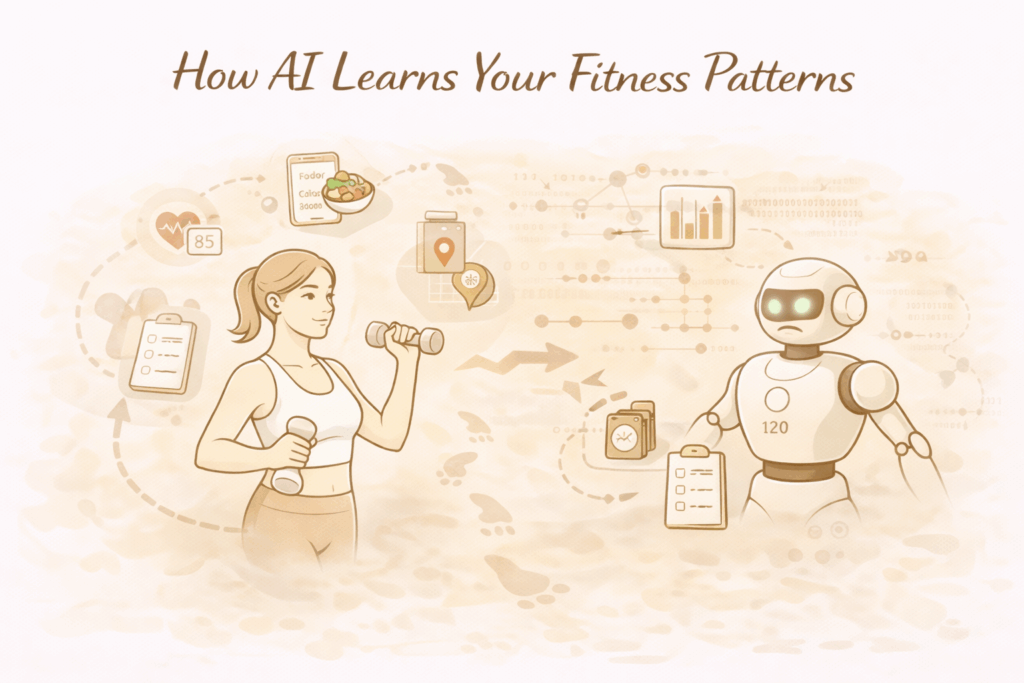
How AI Learns Your Fitness Patterns
For decades, most fitness programs followed one simple idea: one plan designed to work for everyone.
But the human body has never worked that way.
Energy changes. Recovery varies. Some days feel strong, others feel slower. Real progress depends on how well training matches these natural fluctuations.
Artificial intelligence is starting to change this. Instead of forcing a fixed plan, AI systems can learn how you actually train, recover and move- and adjust accordingly.
Your Body Creates Patterns
Your performance is not random. Over time, clear patterns begin to appear. These patterns can include:
- how often you train each week
- which days feel easier or harder
- how long your sessions usually last
- how quickly you recover
Lifestyle also plays a role. Sleep, stress, work schedule and daily movement all influence how your body responds to training.
Research shows that habits begin to form through repeated actions. When a routine is repeated regularly, it becomes easier to follow and more natural to maintain.
AI systems are designed to recognize these patterns. Instead of assuming every day is the same, they observe how your body actually behaves over time.
Small Signals Become Useful Data
Many important fitness signals are small and easy to miss. For example:
- how often you complete workouts
- when you tend to skip sessions
- how long you usually train
- how frequently you need recovery
Individually, these signals may seem insignificant. But together, they create a clear picture of your real routine.
An AI system can use this information to adjust your training.
For example:
- shorter workouts during busy days
- lighter sessions when recovery is needed
- more challenging sessions when energy is higher
This makes training more realistic and easier to follow.
Patterns Help Prevent Burnout
One of the most common reasons people stop training is burnout. Too much intensity without enough recovery leads to fatigue, frustration and eventually inconsistency.
At first, pushing harder may feel productive. But when effort stays high for too long without enough recovery, the body begins to resist. Energy drops, workouts feel heavier, and motivation becomes harder to maintain.
This is where patterns become extremely valuable.
When training behavior is observed over time, certain signals begin to appear:
- frequent skipped workouts
- shorter sessions than planned
- longer gaps between training days
- declining energy or performance
These are not signs of failure. They are signals that the current structure may be too demanding or not aligned with real life. When a system recognizes these patterns, it can adjust before burnout fully develops. Instead of pushing harder, it may:
- reduce workout duration temporarily
- introduce lighter sessions or recovery days
- shift intensity to more suitable days
- maintain movement through simpler routines
This approach protects consistency. And consistency is what ultimately drives results. In many cases, people do not quit because they lack discipline. They stop because the system they follow becomes too difficult to sustain.
By adjusting training based on real patterns, effort becomes more balanced. You continue moving, but in a way your body and schedule can support. This does not remove effort. It simply places it at the right time- when your body is ready for it.
Training Becomes a Feedback Loop
With AI, training is no longer static. Because each session provides feedback, such as: what was completed, how often you trained fo how consistent your routine is.
This information helps shape future sessions.
If consistency improves, the system can gradually increase challenge. If activity drops, it can simplify the plan to make it easier to restart. This creates a loop where your training evolves based on your behavior.
Instead of following a rigid plan, you follow a system that adapts with you. This is also why structured systems tend to work better than relying on motivation alone, as explained in why systems create real transformation.
Why This Matters for Home Fitness
Home fitness already removes many of the barriers that make training difficult to maintain.
- No commuting or travel time
- No waiting for equipment
- No crowded or distracting environments
- No need to reorganize your entire day
This simplicity is not just convenient. It directly affects how often you train.
When starting requires less time, less preparation and less mental effort, it becomes easier to repeat. And repetition is what creates results. When adaptive systems are added to this environment, training becomes even more practical.
Instead of trying to follow a fixed plan, your workouts can adjust to your day:
- a short session instead of skipping entirely
- a lighter workout when energy is low
- a more intense session when you feel ready
This changes the entire experience of training. Instead of asking, “Can I fit this workout into my day?”, you begin asking: “What kind of movement fits my day today?”
That shift reduces pressure and removes the all-or-nothing mindset. Even on busy or low-energy days, movement remains possible. This is what makes consistency easier- not perfect planning, but flexible execution.
It also aligns with how the body actually adapts. Regular movement, even in shorter sessions, supports circulation, energy levels and long-term progress far more effectively than occasional intense workouts.
This is exactly the idea behind the AI Personal Fitness Coach, a system designed to adapt your workouts to your real routine, not the other way around.
Instead of forcing you into a rigid structure, it helps you stay consistent through:
- short, adaptable sessions
- training based on your energy and time
- a structure that evolves with your habits
Combined with the flexibility of home fitness, this creates a system that is easier to follow, easier to repeat and much more sustainable over time.
Fitness That Learns With You
Traditional fitness plans stay fixed. They are created in advance and expected to work the same way every day, regardless of how your body feels or how your schedule changes.
Adaptive systems work differently.
Instead of forcing you to follow a rigid structure, they learn from your behavior. As you train, the system begins to understand patterns such as:
- when you perform best during the week
- how your energy levels change
- how often you realistically train
- what level of intensity you can sustain
This creates a more personalized approach to fitness- not based on assumptions, but on how you actually live and move.
At the beginning, the system is simple. But as you continue, it becomes more accurate. Your routine starts to feel less forced and more natural. This is important because long-term results rarely come from perfect plans. They come from systems that you can follow consistently.
When training adapts to you, instead of you constantly trying to adapt to it, something changes:
- starting becomes easier
- skipping becomes less frequent
- progress becomes more stable
Not because you suddenly became more disciplined, but because the system supports your behavior instead of fighting it.
This is what makes sustainable progress possible. Because results are not built in moments — they are built through what you return to again and again.
Frequently Asked Questions
How does AI track my fitness patterns?
AI systems track basic behaviors such as workout frequency, duration and consistency. Over time, these patterns help adjust future recommendations.
Is AI fitness better than a normal workout plan?
Traditional plans can work, but they are fixed. AI systems can adapt to your schedule, energy and progress, making them easier to follow long-term.
Do I need to be advanced to use AI training?
No. AI systems are often very helpful for beginners because they adjust difficulty and remove guesswork.
Can AI help me stay consistent?
Yes. By adjusting workouts to your real routine, AI reduces friction and makes it easier to keep moving regularly.
Does AI replace discipline?
No. You still need to take action. AI simply makes that action easier to repeat.