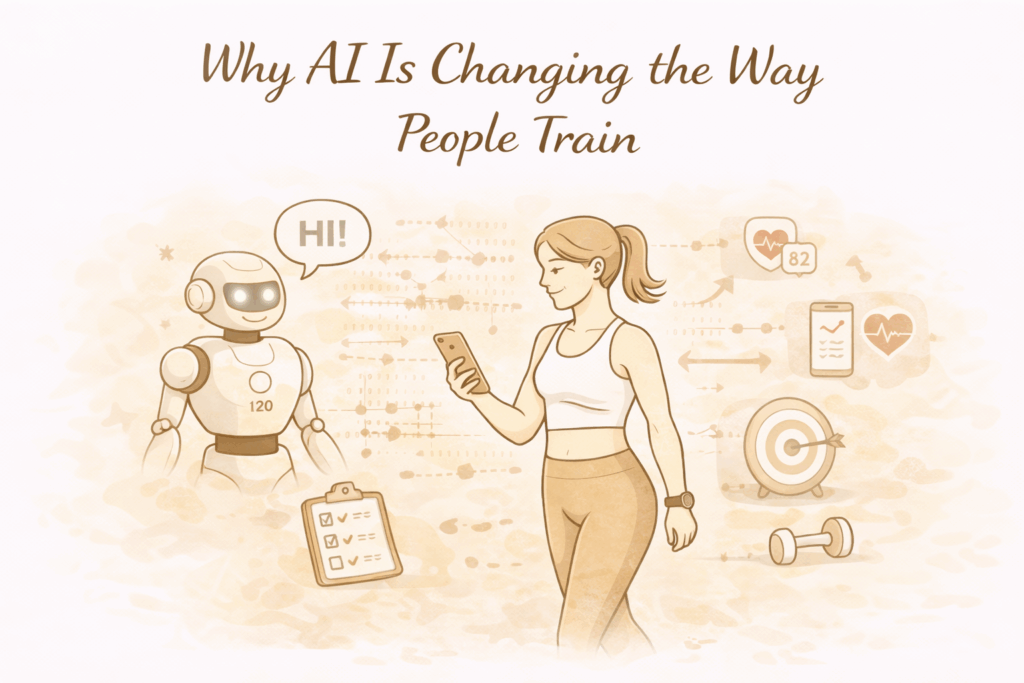
Why AI Is Changing the Way People Train
Have you ever started a workout plan that looked perfect on paper, but stopped matching your life after a week or two? At first, everything feels clear. Monday workout. Wednesday workout. Friday workout. Maybe one recovery day. Maybe one longer session on the weekend.
Then reality appears.
You sleep badly. Work becomes stressful. A meeting runs late. Energy drops. You miss one session and suddenly the whole plan starts feeling broken.
This is exactly where AI is beginning to change the way people train.
Not because it makes fitness effortless. Or because it replaces discipline. But because it can make training more adaptable, realistic, and easier to maintain.
Traditional Training Plans Assume Every Day Is the Same
Most traditional workout plans are written in advance. They assume that your schedule, energy, recovery, and motivation will stay almost the same every week.
Which is completely opposite of how real life works.
Some days you feel strong and ready to move. Other days you are tired, stressed, short on time, or mentally drained. How you slept, how busy work was, how active you have been recently, and how well you recovered from previous workouts can all influence how your body feels on a given day.
That is why the same workout can feel completely different from one day to the next.
And do you know what? That is perfectly normal. Your body is not a fixed template.
Sometimes the right workout is a stronger session. Sometimes it is a shorter session. Sometimes it is recovery, mobility work, or simply doing enough to keep the habit alive.
The problem is that traditional plans rarely account for this reality. They stay fixed while your life keeps changing. And at one moment the plan stops matching your actual situation, consistency becomes much harder.
On the other hand, when training matches how your body actually feels, it becomes easier to start, easier to complete, and easier to repeat.
AI Adapts When Real Life Gets In The Way
Imagine two different mornings.
On Monday, you slept well, feel energetic, and have 30 minutes available. A more challenging session may make sense.
On Thursday, you slept badly, worked late, and only have 10 minutes before leaving the house. Forcing the same workout from Monday may not be realistic.
A traditional workout plan treats both days the same. An adaptive system does not.
Instead of relying only on a fixed schedule, AI can adjust recommendations based on factors such as your available time, recent workouts, energy level, recovery, and overall goals.
And the best part- over time it can begin recognizing patterns too.
Maybe you train more consistently on weekends. Maybe stressful workdays make longer sessions unrealistic. Maybe shorter workouts help you stay active during busy periods.
The result is a plan that gradually becomes more personal and more realistic rather than repeatedly pushing the same schedule regardless of what is happening in your life.
This is exactly the type of adaptive logic used in the AI Personal Fitness Coach , where workouts adjust based on your routine, available time, energy level, and goals.
The Biggest Fitness Mistake AI Can Help Prevent
One of the most common fitness mistakes is treating every missed workout as failure.
The problem is not the missed workout itself. The real problem is the all-or-nothing thinking that often follows.
A smarter approach is asking: “What is the best thing I can do today?” Maybe it is a full workout. Maybe it is a Micro Workout . Maybe it is simply a walk after dinner.
What matters is adjusting instead of stopping completely.
And this is one area where adaptive systems can be surprisingly useful. Instead of treating every disruption as a reason to restart, they help people keep moving forward with whatever is realistic today.
Long-term progress is built on the ability to adapt when life gets messy.
Smarter Training Works Best When It Fits Real Life
Adaptive training does not mean avoiding effort. It means applying effort more intelligently.
Training works best when challenge and recovery remain in balance. That balance is also why recovery is just as important as exercise .
This is one reason AI works especially well with home fitness.
Home workouts already remove many of the barriers that make exercise difficult to maintain. There is no commute, no waiting for equipment, no crowded gym, and no need to reorganize your entire day around a workout.
Instead of adapting your life to training, training begins adapting to your life.
Rather than following the exact same plan every day, workouts can adjust based on your available time, recent activity, energy level, recovery, and goals.
You begin asking: “What kind of session fits me best today?”
We explored a similar idea in Why Movement Actually Creates Energy (Not Exhaustion) , where we explain how regular movement supports energy and performance.
Frequently Asked Questions
What makes AI training different from a traditional workout plan?
A traditional workout plan is usually fixed. It tells you what to do on specific days regardless of how much sleep you got, how stressed you are, or how much time you have available.
AI-based systems can adjust recommendations based on changing circumstances, making training feel more realistic and easier to maintain.
What happens if I miss a workout?
Missing one workout does not erase your progress.
One of the biggest advantages of adaptive systems is that they focus on helping you continue rather than making you feel like you need to restart from the beginning.
Can AI help if my schedule changes every week?
Yes. People with changing work schedules, family responsibilities, travel, or unpredictable routines often benefit the most from flexible training recommendations.
Instead of forcing the same structure every week, adaptive systems can adjust to what is realistically possible.
Does AI always recommend easier workouts?
No. Adaptive training is not about avoiding effort.
On days when your energy, recovery, and available time are higher, it may recommend more challenging sessions. On lower-energy days, it may suggest something shorter or lighter instead.
Can AI help me stay consistent?
Consistency is one of the main reasons people use adaptive fitness systems.
When workouts match your actual situation instead of an ideal schedule, it becomes easier to keep moving even during stressful or busy periods.
Is AI fitness suitable for beginners?
In many cases, yes.
Beginners often struggle because fitness plans feel too rigid or overwhelming. Adaptive systems can make the process feel more manageable by adjusting to individual needs, available time, and progress.