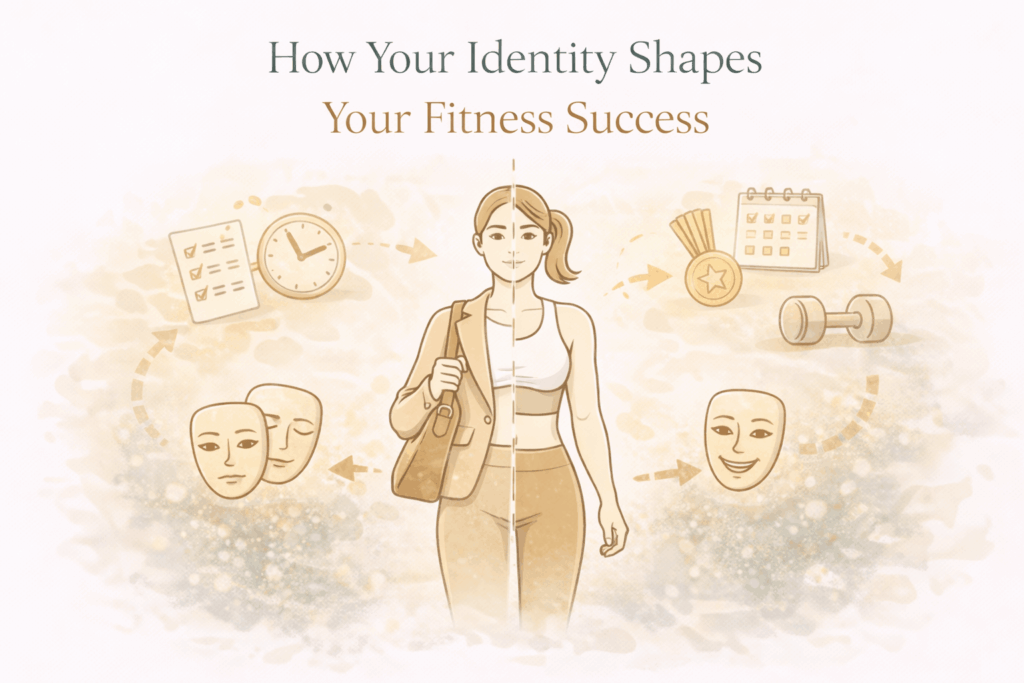
How Your Identity Shapes Your Fitness Success
You finally start going to the gym, but after the first or second workout, you quit. Does this sound familiar? This is a problem for many people because, deep down, they still do not see themselves as someone who can stay consistent.
They start a plan, miss a few days, feel guilty, and immediately think: “This is just me. I never stick to things.”, “I am too tired and busy to change.”, or “I will start in the future, just not now.” Once these thoughts appear, starting again becomes even harder. And unfortunately, that “future moment” often never comes.
This is where identity quietly affects fitness. Not in a complicated psychological way, but in a very real, everyday way.
The way you speak to yourself after missed workouts, stressful weeks, or slow progress can either help you return to the routine… or convince you that you have already failed.
People Often Repeat the Same “Starting Pattern” for Years
A lot of people do not notice they repeat the exact same cycle again and again. They begin with strong motivation for several days, trying to change everything overnight. And after a week or two, the routine disappears completely, and the old habits slowly come back again. Eventually, people start convincing themselves that “the time was not right for change.”
So it is not surprising that after repeating this pattern enough times, people slowly stop trusting themselves, because constantly starting over becomes mentally exhausting. And little by little, they begin believing that “change” is simply not for them.
Because the human brain usually needs two things to build a new habit: time and proof. And that proof is built gradually. It is not like you suddenly wake up feeling like an active person. That feeling usually appears when small actions begin repeating consistently.
Actions, such as: finishing a 10-minute workout; walking instead of staying inactive; eating slightly healthier meals more often, and drinking less alcohol; and most important- returning to movement after a missed day.
We explored this idea further in The Most Effective Short Home Workouts , where shorter sessions can make that first proof much easier to create.
Each of these actions gives the brain a new kind of evidence that change can really happen. And more importantly, you slowly begin proving to yourself that consistency is actually possible.
Missing One Workout Does Not Have to Become Your Identity
“I had a difficult day. I will return tomorrow.” And it is totally fine.
This is very important to understand- one missed workout means very little if you return the next day. People forget that and allow one skipped workout to completely break their routine.
One stressful day, one vacation, or one low-energy evening does not destroy progress. What really creates problems is when one missed workout slowly turns into several days, or avoiding movement completely. This will surely lead to falling back into old routines again.
If you return the next day, even with something small, you keep proving a very different story to yourself.
This is one reason home workouts help many people. They remove the pressure of feeling watched, judged, or compared with others. We explored this further in Why Home Workouts Beat the Gym for Real, Sustainable Transformation .
Small Things That Make New Habits Easier to Keep
One reason people struggle with consistency is because they rely too much on motivation and too little on structure. And when stressful days come, the routine disappears completely.
During stressful periods, people are often surprised how much small practical changes can help healthy habits feel easier to maintain.
- keeping workout clothes visible instead of hidden away
- preparing simple meals before busy workdays
- saving 2–3 easy workouts in advance
- starting with only 10 minutes instead of waiting for “perfect time”
- walking after dinner instead of sitting immediately
- not turning one missed day into a missed week
- keeping alcohol and snacks less visible at home
- choosing movement that feels realistic for your energy levels
These small changes make the habit easier to repeat. And usually, the easier something feels to repeat, the more likely it becomes part of normal everyday life.
One missed workout does not destroy progress. What usually creates problems is disappearing from the routine completely and waiting for another “perfect Monday” to start again.
For people who want a more structured way to rebuild healthier routines gradually, the 30-Day Home Transformation Program was designed around simple workouts and realistic daily movement that fit normal life.
Frequently Asked Questions
Can identity really affect fitness results?
Yes. The way you see yourself affects how you respond to missed days, low motivation, and slow progress. If you believe you always quit, it becomes easier to give up. If you start collecting small proof that you can return, consistency becomes easier.
How do I start seeing myself as an active person?
Start with actions small enough to repeat. A short walk, a 10-minute workout, stretching before bed, or returning after a missed day all help build evidence that movement can be part of your life.
What if I miss several workouts?
Missing workouts does not erase your progress. The important thing is to return without turning the missed days into proof that you failed.
Do home workouts help build fitness identity?
Yes. Home workouts often feel less intimidating and easier to start, which makes them useful for beginners who are still building confidence.
Do I need motivation to change my fitness identity?
Not always. Motivation helps, but small repeated actions usually build stronger confidence than waiting to feel fully ready.